Tuesday, May 24, 2022

P4E.279 A Societal Crossroads


“I shall be telling this with a sigh
Somewhere ages and ages hence:
Two roads diverged in a wood, and I—
I took the one less traveled by,
And that has made all the difference.”
Robert Frost

Eons of human existence resulted in social contracts that allowed individuals to live in relative harmony in society. These social contracts allowed people to communicate and interact with confidence, knowing that the definition of words and social constructs were held in common. We’ve referred to that state of affairs as Western Civilization. We became civilized by the mutual understandings that allow us to live together in relative peace.

If human history was represented as a 24 hour clock, it is only in the last fraction of a second that postmodern deconstruction has laid waste to the social contracts that took eons to bind. Religion and philosophy have been the vehicles that gave meaning to life. Science was welcomed into that circle but has been a double edged sword. It has been useful in answering the questions of what, when, and where. The questions of who and why are still left to religion and philosophy.

Now it seems that every social contract is being brought into question. This has brought about a complete breakdown in trust. We can no longer communicate with confidence. This is forcing us to separate, to segregate, to silo with others with whom we can confidently socialize. Interaction is becoming increasingly difficult, because the unspoken “rules” of engagement are no longer clear. Is authority powerless? Is solid porous? Is uniformity weakness? Is diversity strength? Is black white? Is conservation waste? Is law liberty? Is truth deceit? Is violence peace? Is male female? Is death life?  Is good evil?

This discourse is, by nature, conservative because it implies that order is better than chaos. It relies on thoughtfulness over emotion. It values social contracts over anarchy. But this is the crossroads we approach. Do we devolve into disorder, or can we pull back from the edge and form new social contracts that keep us civil? Time will tell.

“Enter by the narrow gate; for wide is the gate and broad is the way that leads to destruction, and there are many who go in by it.”

Matthew 7:13

Friday, December 24, 2021

P4E.278 Hark! The Herald Angels Sing

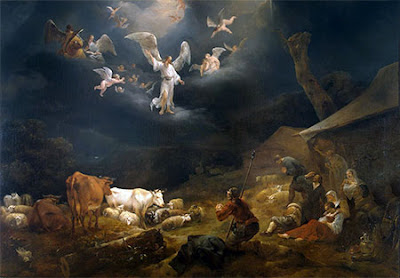
The Annunciation to the Shepherds, Nicolaes Berchem, 1649

I'm recently reminded how laden with meaning the traditional hymns that we sing at Christmas are. Here, as an example, are the lyrics of Hark! The Herald Angels Sing. The hymn we sing at Christmas is the collaboration of two greats, Charles Wesley and Felix Mendelssohn. Lyrics written in the 18th century and music in the 19th. We usually know the first verse of these hymns and have to refer to the hymnal for the following verses. I've been surprised by how rich the second and third verses of this hymn are.

1 Hark! the herald angels sing,
"Glory to the newborn King:
peace on earth, and mercy mild,
God and sinners reconciled!"
Joyful, all ye nations, rise,
join the triumph of the skies;
with th'angelic hosts proclaim,
"Christ is born in Bethlehem!"

2 Christ, by highest heaven adored,
Christ, the everlasting Lord,
late in time behold him come,
offspring of the Virgin's womb:
veiled in flesh the Godhead see;
hail th'incarnate Deity,
pleased with us in flesh to dwell,
Jesus, our Immanuel.

3 Hail the heaven-born Prince of Peace!
Hail the Sun of Righteousness!
Light and life to all he brings,
risen with healing in his wings.
Mild he lays his glory by,
born that we no more may die,
born to raise us from the earth,
born to give us second birth.

God bless you this Christmas!
Peace on Earth.

Wednesday, November 24, 2021

P4E.277 The Impossible, Unbearable, Ennobling Burden


Social media has provided a mask of anonymity that encourages us to write things that we would self-censor in person. In augmented reality, we create avatar-personas that we allow to be much more judgmental and verbally hostile than we are in real-life. The social media feed-back loop that reinforces and rewards our arrogant attitudes is ever present and urges us to write more and more outrageous things and to espouse shocking ideas. We have been brought to a place where so much is considered “unforgivable” and so many are “cancelled”, that many people fear for their future.

In this social/political/cultural atmosphere we’d do well to remember the virtues that Judeo-Christianity has advanced to humanity since the beginning of recorded time.

Humility: If there’s one virtue that Judeo-Christianity has promulgated, it is humility. In the face of an Almighty God, in the Books of the Old and New Testament, the stories that unfold repeatedly teach the lesson of humility. Humility is at odds with arrogance. The arrogance of knowing that the position/opinion/values that one holds are absolutely, undoubtedly correct. Not only correct, but morally true. And that means if another disagrees, they must be immoral liars. Jesus taught humility in Luke 13:


23 And someone said to Him, "Lord, are there just a few who are being saved?" And He said to them, 24 "Strive to enter through the narrow door; for many, I tell you, will seek to enter and will not be able. 25 Once the head of the house gets up and shuts the door, and you begin to stand outside and knock on the door, saying, ‘Lord, open up to us!' then He will answer and say to you, ‘I do not know where you are from.' 26 Then you will begin to say, ‘We ate and drank in Your presence, and You taught in our streets'; 27 and He will say, ‘I tell you, I do not know where you are from; depart from Me, all you evildoers .'28 In that place there will be weeping and gnashing of teeth when you see Abraham and Isaac and Jacob and all the prophets in the kingdom of God, but yourselves being thrown out. 29 And they will come from east and west and from north and south, and will recline at the table in the kingdom of God. 30 And behold, some are last who will be first and some are first who will be last."

This idea of thinking that you have a relationship and would be able to enter only to be told you are not known and to depart must be meant to impart humility. What could be more direct than to be told that the last will be first and the first will be last?

Non-Judgment: Christ repeatedly reminds us that we should not judge. Why? Jesus tells us in Luke 6:

 
36 “Be merciful, just as your Father is merciful. 37 Do not judge, and you will not be judged; and do not condemn, and you will not be condemned; pardon, and you will be pardoned.”

It seems so easy, in these times, to judge and condemn others; so difficult to extend mercy and pardon. But we must consider the humility necessary to be aware that we are guilty of the very things that we are judging and condemning. Later in Luke 6 Jesus says:
 
42 “Or how can you say to your brother, ‘Brother, let me take out the speck that is in your eye,' when you yourself do not see the log that is in your own eye? You hypocrite, first take the log out of your own eye, and then you will see clearly to take out the speck that is in your brother's eye.” 

Forgiveness: It is Judeo-Christianity that has promulgated the virtue of forgiveness in the western world. The One God is presented as the highest good, to be reverenced and followed and emulated. He is described by Moses in Numbers 14:
 

18 “The LORD is slow to anger and abounding in loving devotion, forgiving iniquity and transgression.”


When Jesus gives us the template for prayer in Matthew 6 He says:
 

12 “…forgive us our sins, as we have forgiven those who sin against us…

14 If you forgive those who sin against you, your heavenly Father will forgive you. 15 But if you refuse to forgive others, your Father will not forgive your sins.”


Love: The binding force between all the other virtues is Love. Love provides the humility to consider others before ourselves. Love curbs and softens our hearts towards those whom we would judge and condemn. Love gives us the moral imperative to let go of a grudge. When asked what the greatest commandments were, Jesus responded in Mark 12:
 
29 “…This is the most important: ‘Hear O Israel, the Lord our God, the Lord is One. 30 Love the Lord your God with all your heart and with all your soul and with all your mind and with all your strength.’ 31 The second is this: ‘Love your neighbor as yourself.’ No other commandment is greater than these.”


I have said that Judeo-Christianity holds the key…has always held the key…to the current social/political/cultural climate. The One God is to be held in highest esteem and is to be reverenced, followed, emulated, and loved above all else. Even knowing that it isn’t possible to achieve oneness with God, that the burden is great and un-bearable, we are ennobled even in the pursuit.

Give Thanks!


Tuesday, November 9, 2021

P4E.276 My Will Be Done


The Pastor of our church used the phrase “My will be done” in a homily a few weeks ago. He contrasted it with “Thy will be done” in The Lord’s Prayer. It’s stuck with me.

As I look back over my life, it’s been blessed. I grew up in Highland Park, California. That’s considered “East-LA”. My father immigrated from China when he was a child and my mother is of Mexican descent, born in La Mesa, New Mexico. My father was a federal bank examiner and my mother worked for financial institutions and the local school district. When I was around 10 years old, we moved to Orange County, California. I would say we progressed from lower middle-class to middle middle-class.

I graduated from the California Polytechnic State University at San Luis Obispo, was married at 21 and am still married to the same lovely wife 44 years later. We had 3 sons and now have 3 daughters-in-law and 3 grandchildren. I’ve had a long, fulfilling career as an architect and engineer. I was raised Catholic, left the Church for Protestant/Evangelical/Non-Denominational churches and have now since returned to the Catholic Church.

There have been no major disasters in my life. No tears in the fabric of my being. No huge holes in my heart. I’ve had a good life. For me, this has become a double-edged sword. All this good fortune has brought about expectations. Because things have fallen into place in my life, I expect them to continue to do so. When they do not, even on the smallest level, I find myself put out. I’m impatient, frustrated, and angry. Strangely, when the relatively bigger challenges arise, I’m more patient, more resolved to accept the fates. It’s the small things that gnaw at my longsuffering. Let the paper misload in the printer; let an important phone call be missed; let the customer service person be less than helpful and I’m undone.

My wife regularly (and rightly) points out my lack of gratitude. I used to wonder what gratitude had to do with the challenges I was experiencing. How it would help me endure the internet service that keeps buffering and cutting out?

I want MY WILL to be done! That means, things go right. Without a hitch. No problems. “Well,” my wife wonders, “Where in the world did you ever get the idea that you were entitled to a world with no problems?” She’s right about that. She is right about that.

Becoming aware of the strength of people who are struggling with cancer, who’ve been molested or harassed or mistreated, who’ve lost loved ones in tragic circumstances, who’ve lost a limb, or become completely paralyzed, who’ve failed repeatedly, who are caring for a loved one who’s health is failing, or worst of all, who are losing hope should and does make me feel grateful for my lot in life.

But the Holy Scriptures of my Faith also point out that I should not only be grateful for the good things that have happened in my life but also be grateful for the trials that befall me.


“Consider it all joy…when you encounter various trials, knowing that the testing of your faith produces endurance. And let endurance have its perfect result, that you may be perfect and complete, lacking in nothing.” (James 1:2-4)

I need to be reminded that these trials are meant to turn my attention to the One who is the source of the comfort that gets me through them and why.


“Blessed be the God and Father of our Lord Jesus Christ, the Father of mercies and God of all comfort; who comforts us in all our affliction so that we may be able to comfort those who are in any affliction with the comfort with which we ourselves are comforted by God” (2 Cor. 1:3-4)

In these times, I’m not looking for relief from suffering. I will suffer. If I'm not suffering now, it will surely come. Who will I be when the suffering comes? Will I purposely make it worse? Will my response compound the grief and sorrow? Or will I endure and be a source of strength and comfort to those who need it? I fervently pray that I am the latter. Not mine, but His will be done.

Monday, October 18, 2021

P4E.275 Suddenly


Yesterday
All my troubles seemed so far away
Now it looks as if they’re here to stay
Oh, I believe in yesterday

Suddenly

I’m not half the man I used to be
There’s a shadow hangin’ over me
Oh, yesterday came suddenly
Lennon-McCartney

Being closer to the end of my life than the beginning, these words are resonating with me lately. Not because of a doomed romance, but because of a lost love. The love that seems suddenly lost and dying is the culture that has come to unify the western world over centuries (and possibly millennia or even eons).

My holding to the values and culture that, in my view, best define and direct humanity has me feeling suddenly irrelevant and invisible. Suddenly overshadowed. Suddenly so…yesterday. But I’m not apologetic for holding to those values. The zeitgeist of the 2020s has taken a dark turn. An accusatory, unforgiving, malevolent, destructive turn. It’s as if every institution that gave solidity to existence has been drawn into question. As if every baby is to be thrown out with the bath water.

Let me expand on that metaphor for a minute. The baby is what is considered valuable. The baby’s value resides in its inherent value as a human being. It resides in the baby’s potential and in its innocence. The baby has no power over itself or others. It relies completely on those in whom the baby’s well being has been entrusted. But the baby messes itself. It drools. It plays in the dirt. It can’t completely be fed without getting the food all over itself. It needs a bath.

So, the basin is prepared with warm, clean water. The universal solvent. As soap is applied and the baby is sponged, the dirt, the drool, the mess, and the excess food are washed away into the water. Now baby is returned to its pristine state and the water is no longer clean. Here the metaphor becomes clear: when emptying the basin, the valuable baby should not be tossed away with the dirty water.

The institutions that have held us together are so under fire that they seem close to collapse. There are those that seem intent on throwing them out with the bath water. Are they dirty? Yes. Flawed? Yes. In need of attention/repair/improvement? Yes. But should we destroy them?

Religion and Christianity, in particular, have receded in our culture’s value system. The emphasis on science has unnecessarily relegated Christianity to the sidelines of relevance in the zeitgeist of the 21st Century. Science and Christianity need not be mutually exclusive. They need not and cannot consistently be mutually affirming. They feed different parts of human need.

I recently heard a podcast interview with Jaron Lanier. If you haven’t heard of him, see here: jaronlanier.com . He purposefully has no social media accounts. He started talking about people’s interest in UFOs.

“…(it) fills a human need. People need to have something to obsess over. People need to experience their brains thinking beyond the edge of what’s official. They need to be able to have common quests. The need to be able to explore things that might not be true, because otherwise truth calcifies. This is something that we all need. This is legitimate. Being able to be obsessed with things that are at the edge of thought is really important. Being able to do it with other people is very healthy and maybe even vital.”

Even though he wasn’t talking about religion, and he might even disagree that his words could be used in reference to religion, I found the similarity of thought interesting.

I draw comfort from the shared Judeo-Christian Scriptures: The idea of One Creator God, Who exemplifies eternity, good, truth, light, wisdom gives me solace. He cannot be proven. Those who have ears to hear and eyes to see hear and see Him. But the “not knowing” can and should be the impetus to explore what “might not be true”. There is a man I know and admire who responds to the question, “Do you believe in God?” by saying “I try to act as if there is one.”

There are reasons why the ancient Holy Scriptures encourage us to honor our father and our mother (Deut 5:16), ideally the source of the wisdom of the past. There is a reason why Christ said

“Do not think that I have come to abolish the Law or the Prophets. I have not come to abolish them, but to fulfill them. For I tell you truly, until heaven and earth pass away, not a single jot, not a stroke of a pen, will disappear from the Law until everything is accomplished.”

(Matt 5:17-18)

 We toss aside these ideals at our own peril. The promise associated with the command to honor father and mother: “so that your days may be long and that it may go well with you in the land that the LORD your God is giving you” literally promises longevity and well-being to those who keep the wisdom of the past. The alternative?

Returning to the baby and the bath water metaphor, Jesus brought a child before His disciples and said,

“And whoever welcomes a little child like this in My name welcomes Me. But if anyone causes one of these little ones who believe in Me to stumble, it would be better for him to have a large millstone hung around his neck and to be drowned in the depths of the sea. Woe to the world for the causes of sin. These stumbling blocks must come, but woe to the man through whom they come!” (Matt 18:5-7)

Sometimes I do feel as if the world sees me as “half the man I used to be,” but it helps me to not care what the rest of the world thinks. Not in that regard. I will try not to be the man through whom stumbling blocks come.

 Blessings.

Thursday, October 7, 2021

P4E.274 Honor Your Father and Mother

The commandment to honor your father and mother is vital to the stability of humanity. Historians date the writing of Exodus, where the commandments are recorded, to be as early as 1,450 BC, almost 3,500 years ago. Even then, man had been around for a very long time. Long enough to know, or be taught, how to live and how to live with each other. God and man also both knew the wickedness that man was capable of and what boundaries needed to be put in place. 

The genius of the commandment is that it burdens both parents and children. Parents are obliged to behave honorably by representing God properly and passing down the lessons of the past (I confess that I could have done better in this regard). And through the generations, fathers and mothers were charged with raising their children in the way they should go. Children, in turn, honor God by honoring their parents and carrying on the accumulation of millennia of traditions and values . Children were urged, “Hear, my son, your father’s instruction, And do not forsake your mother’s teaching.”

But Christ knew that men’s hearts are rebellious and that He, Himself, would cause division: “Do you suppose that I came to grant peace on earth? I tell you, no, but rather division…They will be divided, father against son, and son against father; mother against daughter, and daughter against mother…” 

Ultimately, parents die, and their children become parents and all are responsible for their own behavior. Sometimes the evil prosper and bad things happen to good people. And, because God is sovereign and men are inclined to evil, justice is hardly expected here on Earth. 

In the end, the wisest man said that all was futile. When all had been said, he advised us to “fear God and keep His commandments, because this applies to every person. For God will bring every act to judgment, everything which is hidden, whether it is good or evil.”

Thursday, December 5, 2019

P4E.273 You Matter


In the early 2000's my marriage was in deep trouble. We were very fortunate in finding an amazing para-church ministry that helped us find a way through those times. Now, one of the leadership couples of that ministry just announced that, after 24 years of marriage, they are divorcing. They're not the first (and probably won't be the last). Of course, everyone is wishing them well, as do I. But, at my age I feel entitled to have an opinion; to have feelings about it.

Acknowledging all the normal and expected caveats of, "you haven't kept in touch with them, you don't know their pain, you don't know all the particulars, the history, the circumstances, how things change, you can't and shouldn't judge, there but for the grace of God go I, etc.," it still hurts. It's still confusing and discouraging and disappointing. It still leaves me desperate and wondering.

In the para-church ministry I mentioned, emphasis was placed on the husband, as spiritual leader, being responsible for the state of his marriage. To love his wife like Christ loved the church, "and gave Himself up for her." As that leadership couple taught me, I've come to believe this wholeheartedly and so lay the responsibility for the split at the husband's door. I know that I'm walking a fine line between holding him accountable and judging him; that I leave myself open to being called a hypocrite myself (now and in the future). But in this moment, that is what I feel and believe. We were taught, by this couple, that the state of the marriage is an accurate reflection of the state of the husband's relationship to Christ. What must that relationship be like if they have decided to divorce?

There are very few men who have influenced me. One, who I've recently come under the influence of, says that life is struggle. That the antidote to that struggle is discovering meaning. And that meaning can be found in taking on responsibility. That responsibility comes about when we shoulder the burden that EVERYTHING WE THINK, SAY, AND DO MATTERS. Each one of us knows 1,000 people. And each of them knows 1,000 people. So, we are literally 1 person away from 1,000,000 people. We are individuals, but we live in a society and a culture. This is only compounded by social media. By what we think, say, and do, each of us MAKES A DIFFERENCE in the lives of others. (At this time of year, the story of "It's a Wonderful Life" comes to mind)

I know that I'm not the only one so deeply affected by that leadership couple's decision to divorce. All this is meant to be an encouragement to you, my friends. What you THINK, SAY, and DO matters. Lean into the struggle. There will be pain. Tears must fall. Find the meaning in it. Bear your burden. Endure.

"Consider it all joy, my brethren, when you encounter various trials, knowing that the testing of your faith produces endurance. And let endurance have its perfect result, that you may be perfect and complete, lacking in nothing." James 1:2-4

PS - I know that, just as in my favorite sport of Baseball, the story isn't over until it's over. We always hold out hope!

Friday, August 17, 2018

P4E.272 The Wolf and the Lamb


I'm thrilled and honored to be a new contributing writer to Thriving Marriages.
Here's the first article published there. It's a very diffcult subject because it hits so close to home:

The #MeToo movement has shone an uncomfortable light on the fact that many women have been, and continue to be, vulnerable prey to men who behave like predators. I know that some people dismiss the idea of men being predators as trite, but I’m curious and wonder what spiritual lesson we might learn from these physical circumstances? Of course, we know that outright sexual assault is not to be tolerated, but do we husbands sometimes act like predators? Do we even know what it means to act like a predator? And what would we do about it if we did know?

Some years ago my wife, Gwen, bought Sterling, a silver dun Quarter Horse. She started to study “natural” horsemanship. As Gwen began to share what she was learning, I was struck by the similarities between human/horse relationships and husband/wife relationships. Through Gwen, I learned that horses are stereotypical prey animals and identify humans as predators.

Gwen and I have been married for over 40 years.  We were fortunate to have made it past 10 years. Due to my ungodliness, by the time 24 years rolled around, our marriage was in real trouble. By God’s grace and with the guidance of a unique parachurch ministry, our marriage has healed to the point where Gwen and I now minister to other married couples in crisis. But, before I began to get well our marriage could be characterized as a predator/prey relationship. I was not physically abusive, but engaged in more subtle, though no less damaging, spiritual/emotional predator behavior.

Gwen has helped me to see that certain things I do, physically, make her feel like prey. If Gwen says something that I don't understand, or disagree with, I might frown (which knits my eyebrows and squints my eyes).  I might raise my voice. I might even make a guttural noise that sounds like a growl.

More spiritually damaging is my predator attitude, which is negative, confrontational, and critical. At its heart, being a predator is selfish. As difficult as it is to admit that I have this attitude, it comes down to this: "I come first at your expense. My survival comes first. My priorities, values, desires, attitudes, ideas and comfort come first. I cannot control my emotions or aggressiveness. They are my unchangeable nature. I act on instinct before I think. I look for weakness and exploit it when I find it. I can be sneaky or I can be blatant; whatever it takes to win. I'm intense. I'm a straight-line thinker; very predictable and not very creative. Fear me. I can and will hurt you.”

When a prey animal feels threatened, it may try to go undetected by remaining still and quiet or camouflaging itself to blend with its surroundings. As a wife and mother, Gwen protected herself and our sons when she felt they were in danger of being spiritually harmed. She’d try to "go silent and unnoticed" and encouraged our sons to do the same. By not engaging in arguments with me, Gwen kept her conscience clear, and herself and our sons out of harm's way.

Some prey animals, like horses, will flee to escape their predator. Gwen has turned on her heel and walked away, just to escape from an argument with me. Finally, when cornered, some prey animals will fight. Gwen has told me that when we would argue, she would feel trapped and threatened. She felt like she was going to get eaten up, so she would fight for her life.

In line with how prey responds to its predators, Gwen lost trust in me. I drove her to resentment, bitterness, and coldness towards me.

When my marriage finally hit rock-bottom, I began to seek godly counsel. At one point my counselor told me, “All God wants is for you to change the way you think, act and talk.” (That’s all!?!) Because the predator attitude came so naturally to me, I didn't even know I was doing it when I was doing it. It was easier to see it in others, but almost impossible to identify it in myself. I needed help. Ken Nair, author of “Discovering the Mind of a Woman,” advised where I might get help to change: "Could God be so uncomplicated as to call the help He has provided for us husbands 'help'?” Taking that advice, I’ve asked Gwen to help me by suggesting some steps I could take to change the predator in me. Here are just three of her ideas.

The first idea is to slow down. Predators are naturally quick, aggressive, and direct in the pursuit and capture of their prey. To counterbalance the “act without thinking” patterning, I have to slow down. I have to slow down with my harsh words and with my anger. To my shame, I’ve pounced on my wife's mistakes. I’ve corrected Gwen in public, causing her great embarrassment. I’ve become impatient if she were not ready to leave when I was. When I slow down, I have time to think, to gain wisdom and understanding.  This is an exercise in patience, a fruit of the Spirit.

"But everyone must be quick to hear, slow to speak and slow to anger; for the anger of man does not achieve the righteousness of God." (Jas. 1:19-20 NAS)

The second step is to let others go first. Since my natural predator nature is selfish, I do the opposite of what comes naturally and let others go first. It could look like this:

I'm in a hurry. I arrive at a queue at the grocery store, bank, or fast-food place at about the same time as someone else. I let them go in front of me.

I'm late for an appointment. I sense that the person driving next to me wants to squeeze himself in the impossibly short distance between me and the car in front of me, with never a turn signal. I back off and let him in.

Gwen has an idea that’s contrary to my own. I have very good, logical reasons why my idea is better. I freely sacrifice my idea and get behind hers. It is beneficial for me to willingly give up my opinions and count hers as more important than mine.

“Don't be jealous or proud, but be humble and consider others more important than yourselves.” (Philippians 2:3 CEV)

Gwen’s third suggestion is to have a change of heart. I think it’s significant that Scripture characterizes the golden age the Messiah will usher in as a time when "the wolf will dwell with the lamb." (Isaiah 11:6 NAS).  As part of our pursuit of Christ-likeness, we husbands must change our hearts and stop acting like predators towards those who are close to us. If what is in our hearts is dark and aggressive, our body language, facial expressions, and words will mirror what’s in our hearts. Better to dwell on what is true, pure, and peaceful. What our wives want is the consistency of character that exhibits patience, kindness, and gentleness; a relationship where they can feel safe and even protected by us.

"The good man out of the treasure of his heart produces good, and the evil man out of his treasure produces evil; for out of the abundance of the heart his mouth speaks." (Luk. 6:45-46 RSV)

Finally, predators are prey for other animals at least some time in their lives. We are, all of us, spiritual prey, all of the time. Sin is our primary predator. It is "lying in wait for you, ready to pounce; it's out to get you..." (Gen. 4:7 MSG).  So, whether we see ourselves as predator or prey, ultimately, we need a Savior.

Friday, October 27, 2017

P4E.271 Entitled Lives


We must constantly remind ourselves that we are not entitled to lives without:

Annoyances
Misunderstandings
Disagreements
Setbacks
Mistakes
Fear
Sadness
Unfaithfulness
Failure
False accusations
Unfairness
Rejection
Hostility
Cruelty
Injustice
Prejudice
Abuse
Harassment
Poverty
Discomfort
Pain
Injury
Illness
Death

In America, we may have laws that punish those who practice some of them, but the reality is that we are not exempt from experiencing them.

The challenge is that we must live in community with other human kind. Although we have tremendous capacity for good, we also have a natural tendency toward selfishness, greed, jealousy, pride, and lust.

When we encounter the things that upset us, those circumstances bring about opportunities to develop positive character qualities and pursue our capacity for good.

We have a real propensity to make a bad situation worse; to match and even escalate the negativity that comes our way. But, in our better moments, we can exercise self-control and practice grace and forgiveness, love, joy, peace, patience, kindness and goodness.

Let’s do good.

Saturday, August 26, 2017

P4E.270 It's A Very, Very Mad World


There are no situations or circumstances in the world right now that wouldn’t be helped by a whole lot of Jesus. I don’t mean we need more church or more worship music. I don’t mean we need a revival or more religion or evangelism or fundamentalism. I don’t mean the Jesus invoked by some or rejected by others.

Who we need is the man who is the Son of God. The Jesus we need is the Prince of Peace. He didn’t come to judge the world, but to save the world. He warned us not to condemn so that we would not be condemned.  The Jesus I’m talking about encourages us to love God and to love each other; to treat each other in the way that we would like to be treated. He told us to forgive, so that we would receive forgiveness. He blessed the merciful and exemplifies justice and mercy and faithfulness.

This Man is a raconteur and asks more questions than He gives answers.  He is a true, righteous, faithful friend. Jesus is the Light of the World and in Him there is no darkness. He is the Rock that we can stand on when there’s shifting sand all around. And Jesus is our Shelter from the storm. He is our Help and our Salvation.

What the world needs now is Love, Sweet Love. And that is exactly what Jesus is: Love. We who know Him need to represent Him well right now, by exhibiting all of His qualities to our fullest. After all, He is our Good Shepherd and we should follow Him and His voice. Peace unto you.

Monday, June 5, 2017

P4E.269 Dark Matter


The intersection of science and religion has always interested me. An exchange between CNN’s Fareed Zakaria and his guest Brian Greene, a week ago (May 28, 2017), really caught my attention.

Fareed Zakaria introduced Brian Greene as “one of today's foremost scientists, a master of super-string theory, the host of Nova shows and the co-founder of the World Science Festival, which kicks off this week in New York City.”

Here’s a part of the transcript of the show:
- - - - - - - - - - - - - - - - - - - - -
ZAKARIA: …for example, I'll give you one that even I struggle with, dark matter.

GREENE: Yeah.

ZAKARIA: I just don't understand it. It's one of these things where you're told, "OK, most of the universe is actually made up of dark matter, and we can't see it; we can't touch it; we can't feel it; we don't know, kind of, know what it does and we don't know why it exists."

GREENE: Yeah.

ZAKARIA: So what am I to make of that?

(LAUGHTER)

GREENE: Well, that's actually a thrilling idea, if you can wrap your mind around it. So you mind spending 30 seconds on dark matter, just for the heck of it?

ZAKARIA: Yeah.

GREENE: So when we observe galaxies, we find that they're spinning around at such a rate that stars on the edge should be flung outward, sort of, like water droplets on a bicycle wheel that's spinning fast. The water gets flung out. But the stars aren't getting flung out. Something must be holding them in. We don't see anything that can do that. But we know gravity has the power to hold things together. So we imagine that maybe there's some matter out there that we don't see, dark matter -- that's why we don't see it; it doesn't give off light -- and that matter is exerting a gravitational pull, holding those stars together in these spinning galaxies.

And when we make that hypothesis, it explains observations so spectacularly well that we begin to gain confidence that maybe the stuff that we haven't yet seen and we haven't yet touched or smelled yet, maybe it's real. So we build big detectors and we try to capture one of the dark matter particles. We haven't succeed yet, but I think that we will.

So this is a beautiful example of how observations drive rational thinking to explain the facts and ultimately verify it through observation and experiment that can be replicated. That is what science is. And that is what can get your heart pounding, when you realize that the human intellect can figure out things about the universe that you wouldn't expect, based on casual observation.
- - - - - - - - - - - - - - - - - - - - - - - - - -

What caught my attention was that a foremost scientist found it a thrilling idea that “maybe the stuff that we haven't yet seen and we haven't yet touched or smelled yet, maybe it's real.” (italics and underline mine)

I rarely quote Scripture in response to situations such as these, but this seems to relate so concretely to the subject at hand, that I can’t help but point it out. Speaking of God, Paul says in Colossians 1:16-17

“For by Him all things were created, both in the heavens and on earth, visible and invisible… all things have been created by Him and for Him. And He is before all things, and in Him all things hold together.” (italics and underline mine)

It’s also very interesting to me that scientists have chosen to call this unseen phenomenon, “dark matter.” Another related phenomenon is called a “black hole.” On the other hand, God is light (I John 1:5). John 3:19 says, “And this is the judgment, that the light is come into the world, and men loved the darkness rather than the light…”

I believe that science and religion will ultimately be resolved. We now have in common that both scientists and Christians believe in things unseen. I find that for me, rather than dark matter and black holes, it’s easier and a much more comforting, enjoyable, stretch of the imagination to believe in the unseen personal, loving, Creator God.

“For the scientist who has lived by his faith in the power of reason, the story ends like a bad dream. He has scaled the mountains of ignorance, he is about to conquer the highest peak; as he pulls himself over the final rock, he is greeted by a band of theologians who have been sitting there for centuries.”
Robert Jastrow, God and the Astronomers

Tuesday, February 21, 2017

P4E.268 Hypocrite


I had a conversation with my wife, Gwen, yesterday. At a certain point, Gwen posed the question, "If you believe that, then why do you act the way you do?"

It's a fair question. I don't think I'm alone in my hypocrisy (although maybe I am). Why do men (and here I AM purposely posing the question about men, but women are welcome to voice their opinion) think/believe one way and act another? I have my theories, but I wonder what you think?

How is it that we can set aside heartfelt beliefs, intellectually thought through ideas, values that we hold dear, and think act and speak things that are detrimental to our own well-being?

Why do we do things that we know are bad for us? How can we be so inconsistent? What causes us to be so hypocritical? Am I the only one?

Friday, February 17, 2017

P4E.267 Speak In


Given the times we are living in, I am sometimes tempted to speak out. But, the better part of me tells me that physical circumstances are put in my life to teach me spiritual lessons. The better part of me propels me to contemplative self-examination. I realize that I have little to no hope of influencing the wide world of politics or government policy. However, I have every hope of positively influencing my own spirit and the spirits of those around me. Instead of speaking out, I speak in.

In that spirit, I'm checking myself: Do I have an inflated view of my own importance? Am I reactionary? Am I careless with my words, thoughts and actions? Am I judgmental? Am I fast and loose with the truth to my own benefit? Can I be dismissive of others' perspectives?

As well as: Am I overly prone to fault-finding and criticism? Am I guilty of telling only the side of the story that fits my view of the world? Can I be cynical and sarcastic? Do I wield whatever power I have with malice? Can I be fake?

The truth is that I'm guilty of all of these things and it harms those whom I come in contact with, especially those closest to me. I really only have power over me and the atmosphere that I create around me. I can make it a bomb or a balm. I can be toxic or a tonic. It's my choice. The better part of me says, choose life, choose light, choose good humor, choose patience and kindness and goodness. Choose love and peace.

P4E.266 Discovering the Mind of a Woman


Some people laugh at the title of Ken Nair's book, Discovering the Mind of a Woman.
And that's part of the problem, isn't it?
The problem that we've been told that it's impossible; that women are from Venus and men are from Mars and that we men simply aren't able to crack the code of a woman's mind. The problem that it's been implied (as horrible as it sounds to read it aloud) that it wouldn't be worth the effort to discover what's in there.

And yet, the Scriptures admonish us husbands to live with our wives in an understanding way.
This is the paradigm shifting message of Ken's book and ministry: That we men have simply had no instruction in how to understand our own spirits or the spirits of those we come in contact with, especially our wives. That we have not had impressed on us the importance of our representation of Christ. That, even though it may not be our fault that we have not had such teaching, we are still responsible for producing the fruit of the spirit: love, joy, peace, patience, goodness, kindness, faithfulness, gentleness, and self-control (especially in our marriage).

I've devoured this book several times. Every page is underlined, noted, and highlighted. I've come to believe that Ken is a sort of prophet, crying in the wilderness of Christian marriages, "Repent, for the Kingdom of Heaven is at hand." His message is at the same time convicting and encouraging. It was, and continues to be, an epiphany to me. I have come to believe that the state of my marriage is a true reflection of the state of my relationship with Christ. When I am angry, impatient, and frustrated, God has used Ken to remind me to check myself. To check my spirit. To check my relationship to my Creator. And that's a good thing.

This year Gwen and I will celebrate 40 years of marriage. It is truly due to the influence of Ken and his book, Discovering the Mind of a Woman. If it were not for Ken, his ministry, and his book, I surely would have fallen. Thanks, for helping me get my life back, Ken. God bless you.

P.S. - An important follow-up to this post is that just because I can sing the praises of Ken Nair and his book does not mean that my marriage is in great shape. In fact, for some time, it has not been. I've been failing to represent Christ well to my wife. Part of the motivation for writing the review was to remind myself of who I'm supposed to be. One of the many ways that I can be offensive to Gwen (And here is one of the downfalls of reading the written word. You cannot tell my tone. I'm not being sarcastic or dismissive. Here, I mean to be sincere and heartfelt.) One of the many ways that I can be offensive to Gwen is that I can make other people think that I'm a nice guy, when I'm not. This might cause others to think she's crazy when she complains. Ken knows what I'm talking about. So, I might even be compounding that effect by writing this post-script. I apologize for that.

In any case, my own failings do not diminish the importance of Ken's book, or his ministry. They help us husbands by setting a benchmark by which we can monitor our pursuit of Christlikeness.  I'm rededicating my efforts to be the man God wants me to be because of Ken Nair, his book and his ministry. Thanks, Ken.

P.P.S. - You might think, man, that's TMI. The reason I've posted this is to give some transparency and permission to my friends to call me on my BS, when I'm shoveling it out. There, you have it.

Tuesday, August 18, 2015

P4E.265 The Divine Within


The Divine within each of us speaks, encouraging us to be kind and generous.
It inspires us to do the right, though more difficult, thing.
But, there is no coercion.
We choose how we will think, speak, and act.
When we are aware of the Sacred within us, 
everything falls into order
and our thoughts, words and deeds
reflect that awareness.
When we forget that the Divine dwells in us, we unravel into chaos.
We forget who we are.
But, the Divine is patient and forgiving when we choose poorly.
So should we be with ourselves and with others.

Friday, June 12, 2015

P4E.264 It's Not Selfish

It's not selfish
or self-centered
to focus on yourself
if the focus
is to become
more
kind, generous, and forgiving
and less
angry, impatient, and judgmental